Recently, the 20th Meeting of the Conference of the Parties to the Convention on International Trade in Endangered Species of Wild Fauna and Flora (CITES CoP20) concluded successfully in Samarkand, Uzbekistan. Miao Zhen, a doctoral student in the College of Wildlife and Protected Areas at Northeast Forestry University (NEFU), attended the meeting as a member of the Chinese government’s delegation and delivered statements at the conference, contributing to substantive progress on two agenda items during negotiations.
CITES is one of the most influential multilateral environmental agreements governing international trade in wild fauna and flora. Since entering into force in 1975, CITES has played a key role in regulating international wildlife trade and promoting the sustainable management of species.
This year’s conference coincided with the 50th anniversary of CITES and drew over 3,000 participants from 164 Parties and 209 organizations. Miao Zhen focused on two key agenda items: “Livelihoods and Community Engagement” under the theme “CITES and People”, and “Disposition of Confiscated Specimens” under “Trade Control and Regulation”. He actively participated in case preparation and negotiations, attended Asian regional meetings, coordinated positions among multiple parties, and leveraged his professional expertise to serve as a bridge for international communication.
During the “Livelihoods and Community Engagement” agenda item, Miao Zhen drew on his years of research in wildlife conservation biology to advance the adoption of decisions on the “certification and labeling system” for products from CITES-listed species. This provides a theoretical basis for legally sourced wildlife products to enter international markets and offers technical and management support for exploring models that balance wildlife conservation with socio-economic development. During negotiations on the “Disposition of Confiscated Specimens” agenda item, Miao Zhen addressed a proposal to remove research institutions’ eligibility to receive confiscated live wildlife specimens. Drawing on his solid professional expertise, he demonstrated the proposal’s negative impact on wildlife conservation and management. His contributions helped prevent the proposal’s adoption, maintaining research institutions as legitimate recipients of confiscated wildlife and ensuring that confiscated wildlife resources continue to support scientific research and conservation practice worldwide.
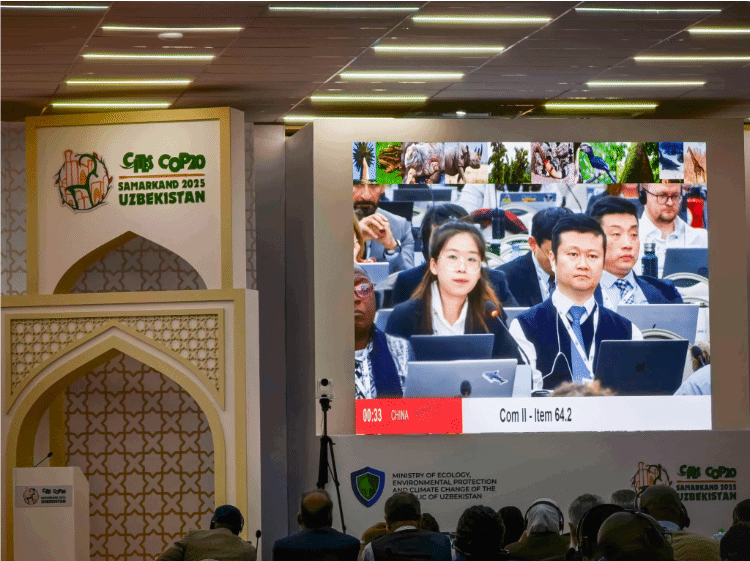
The outstanding performance of NEFU students at the CITES Conference of the Parties not only exemplifies the contributions of young Chinese researchers to international wildlife protection but also highlights NEFU’s strong disciplinary foundation and achievements in cultivating talent in wildlife conservation.


 CN
CN