On October 30th, the 2025 China Science and Technology Journal Citation Reports (Core Edition) were released in Beijing. Four journals published by Northeast Forestry University—the Journal of Forestry Research, the Journal of Northeast Forestry University, Plant Research, and Forest Engineering—were selected for inclusion in the 2025 Core Edition: The Natural Sciences Volume. Among them, the Journal of Forestry Research (JFR) was recognized in several key sections of the report. It was included in the “2025 Key Metrics of China’s Science and Technology Journals,” highlighting the international impact of Chinese S&T journals. JFR also ranked among 44 journals in the top 25% (Q1) of their discipline by total citations, making it the only forestry journal in this category. In addition, it was listed among 172 journals in the top 25% (Q1) by impact factor, with JFR ranking among the top two forestry journals.
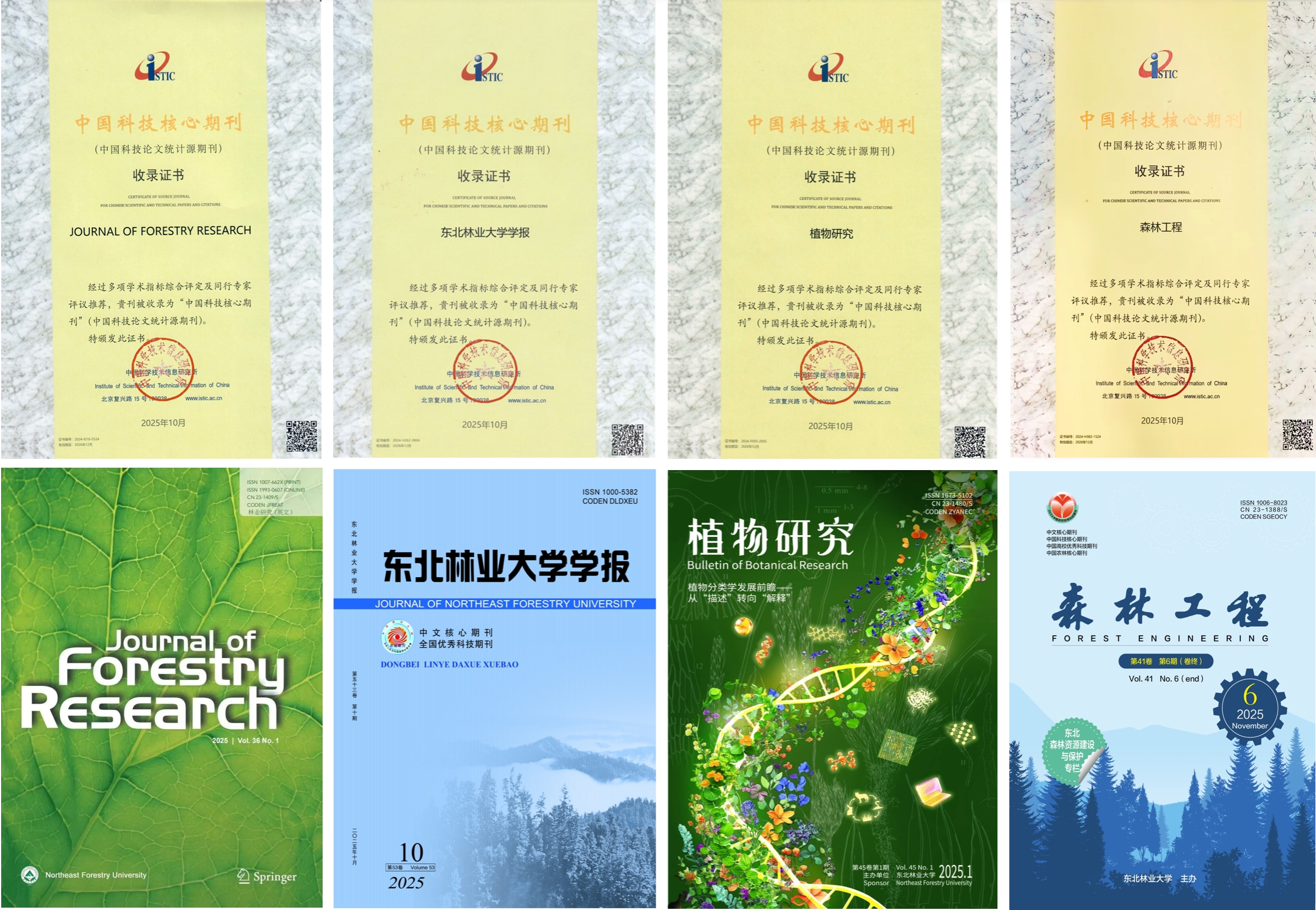
The China Science and Technology Journal Citation Reports (Core Edition) are compiled annually by the Institute of Scientific and Technical Information of China through a rigorous process that combines both quantitative and qualitative evaluation, with ongoing adjustments. In 2025, a total of 2,745 journals (2,693 academic journals and 52 popular science journals) were designated as China Science and Technology Core Journals (China Science and Technology Paper Statistical Source Journals). Of these, only 84 journals were newly submitted and ultimately selected for 2025, representing an acceptance rate of approximately 10.6%.
The selection of four NEFU-hosted journals for the 2025 China Science and Technology Core Journals highlights the important role and academic growth of NEFU’s journals in their respective fields. The Journal Management Office will use this achievement as an opportunity to further develop journal management and growth, improve academic quality, increase overall influence, and continue supporting the journals’ contributions to disciplinary advancement, talent development, and educational exchange.


 CN
CN