Recently, with support from the Carbon Neutrality Interdisciplinary Program and the Ecosystem Big Data Research and Development Center, NEFU’s Multi-source Remote Sensing Forest Ecosystem Monitoring and Evaluation Team has made new advances in research on global assessments of forest sustainability. The related findings, titled “Synergies within and potential barriers to global forest sustainable development,” were published in the international journal Sustainable Development, a top-tier (Q1) journal in Development Studies, ranked first among 65 journals and with a five-year impact factor of 9.5.
Sustainable forest development is a critical foundation for maintaining ecosystem stability, ensuring the long-term supply of forest resources, and enhancing the carbon sequestration capacity of terrestrial ecosystems. However, a unified understanding of the synergistic relationships within the global forest sustainability system, as well as its key barriers and driving mechanisms, remains limited. To address this issue, the research team integrated multi-source remote sensing data, socioeconomic data, and forest resource statistics to construct a global forest sustainability index. Using this index, the team systematically evaluated the spatiotemporal patterns of global forest sustainability. The analysis revealed the coupling and coordination characteristics between natural ecological and socioeconomic systems, as well as the potential barriers and major driving mechanisms.
The study found that from 2010 to 2020, forest sustainability in 73 countries showed an overall upward trend, although significant differences existed among countries, and clear spatial clustering patterns were observed. Forest sustainability hotspots were mainly located in South America, whereas cold spots were concentrated in North Africa and parts of Eastern and Northern Europe. Countries with higher levels of forest sustainability generally exhibited better coupling and coordination between natural ecological and socioeconomic systems. Forest stock volume was identified as a key barrier to improving forest sustainability. Compared with socioeconomic factors, natural drivers exerted a more significant influence on changes in forest sustainability.
The team’s research integrates the spatiotemporal advantages of remote sensing, the explanatory power of forest ecology, the analytical capabilities of socioeconomics, and the comprehensive diagnostic capacity of data models. At the global scale, it advances understanding of the internal synergistic effects, spatial differentiation patterns, and potential barrier mechanisms that affect forest sustainability. It provides a new quantitative framework for assessing global forest sustainability. Meanwhile, the findings indicate that NEFU’s Future Technology College’s Carbon Neutrality Interdisciplinary Program is gradually developing distinctive research directions and innovative research paradigms as it promotes deeper interdisciplinary integration.
The paper’s first author is Liu Zi’an, a PhD student in the Class of 2025 at the School of Future Technology, who the Multi-source Remote Sensing Forest Ecosystem Monitoring and Evaluation Team jointly supervised. This achievement demonstrates the college’s effectiveness in cultivating interdisciplinary talent through the Carbon Neutrality Interdisciplinary Program.
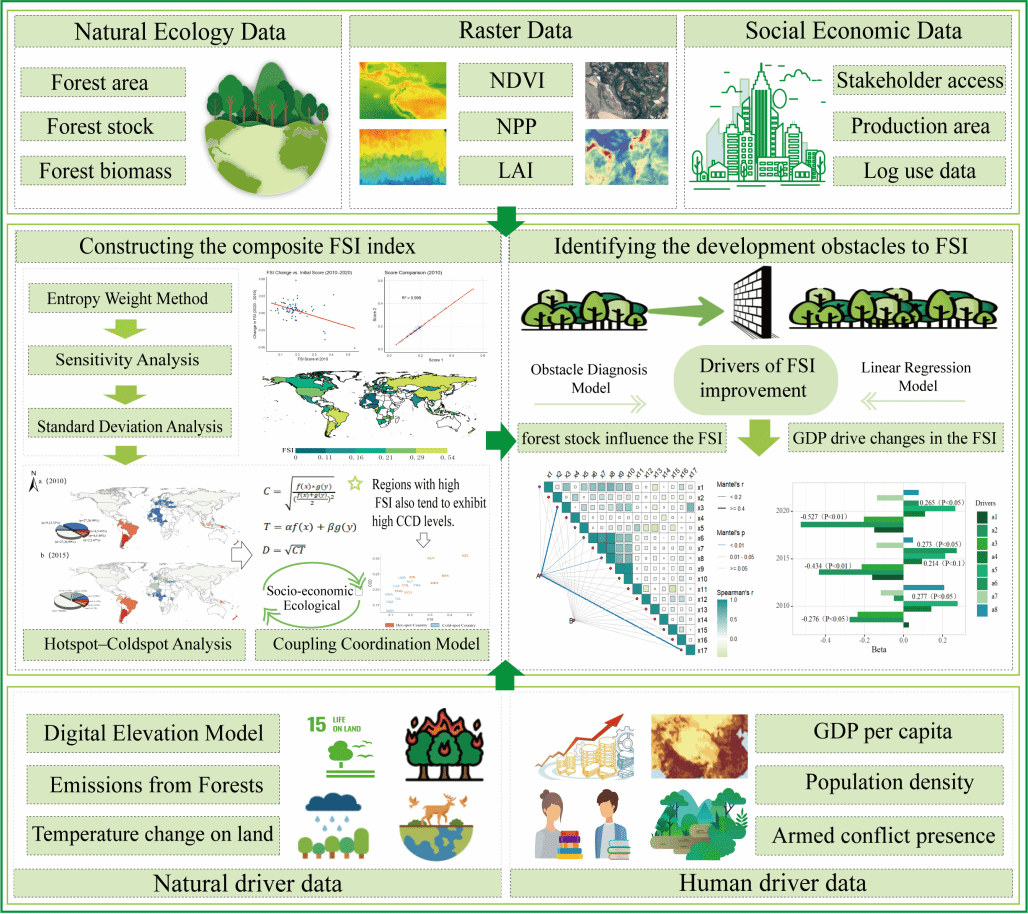
Technical framework of the study
Full paper available at: https://doi.org/10.1002/sd.70735

 CN
CN