From July 19 to 22, the First Academic Symposium on Wildlife and Plant Identification took place in Harbin, Heilongjiang Province.
The symposium was jointly organized by Northeast Forestry University, the Ministry of Public Security’s Institute of Forensic Science, Nanjing Police University, Southern Medical University, the China Entry-Exit Inspection and Quarantine Association, and the Forensic Science Branch of the China Association for Instrumental Analysis. Northeast Forestry University and the Criminal Technology Corps of the Heilongjiang Provincial Public Security Department co-hosted the event. More than 160 experts and scholars from forestry and grassland administration, public security, customs, research institutions, forensic appraisal organizations, biotechnology companies, and other sectors gathered in Harbin for the event.
The opening ceremony was held on the morning of July 20 and presided over by Xu Yanchun, Director of the Wildlife and Plant Testing Center of the National Forestry and Grassland Administration and a professor at Northeast Forestry University. Song Wenlong, President of Northeast Forestry University; Liu Chao, Member of the Chinese Academy of Engineering and Distinguished Professor at Southern Medical University; Tian Xuemei, Level-I Chief Superintendent of Police Technology at the Ministry of Public Security’s Institute of Forensic Science; Shi Ronghong, Director of the Compliance Division of the Department of Wildlife and Plant Conservation of the National Forestry and Grassland Administration; and Fang Qiqiong, Deputy Secretary-General of the China Entry-Exit Inspection and Quarantine Association, attended the opening ceremony and delivered remarks.

President Song Wenlong delivered remarks at the opening ceremony.

Academician Liu Chao, Chief Superintendent Tian Xuemei, Director Shi Ronghong, and Deputy Secretary-General Fang Qiqiong delivered remarks.
During the symposium, the School of Wildlife and Nature Conservation at Northeast Forestry University signed cooperation agreements with the Criminal Technology Corps and the Narcotics Control Corps of the Heilongjiang Provincial Public Security Department. The parties will jointly establish a Joint Laboratory for Forensic Identification of Wildlife and Plants and a Joint Laboratory for Technical Research on the Prevention and Eradication of Illicit Drug Cultivation. The two laboratories were also officially inaugurated during ceremonies.
On the afternoon of July 20, the symposium hosted a thematic forum titled “The Development of Wildlife and Plant Detection and Identification Technologies: From History to the Future.” Sun Meng, Secretary of the CPC Committee of Northeast Forestry University; Li Jian, Member of the Chinese Academy of Engineering; former President Yang Chuanping; former Secretary of the CPC Committee Zhang Zhikun; former President Li Bin; Meng Xianlin, Chair of the Board of Supervisors of the China Wildlife Conservation Association; Zhang Zhizhong, former Director of the Department of Wildlife and Plant Conservation of the National Forestry and Grassland Administration; Zhang Shanning, former Deputy Director of the Department; Jiang Xianhua, former Director of the Liaoning Institute of Criminal Science and Technology; Li Wanshui, Director of the Forensic DNA Technology Division of the Ministry of Public Security’s Institute of Forensic Science; and other experts, scholars, industry regulators, and business representatives participated in the discussion. Participants reviewed the development of wildlife and plant identification in China, tracing its evolution from its early beginnings to today’s diversified and multidisciplinary landscape. They engaged in in-depth discussions on key issues, including disciplinary system development, talent cultivation, technological innovation, and integrating research with practical applications. The discussions helped chart a path and build consensus for the sector’s long-term, high-quality development.

Secretary Sun Meng delivered remarks.
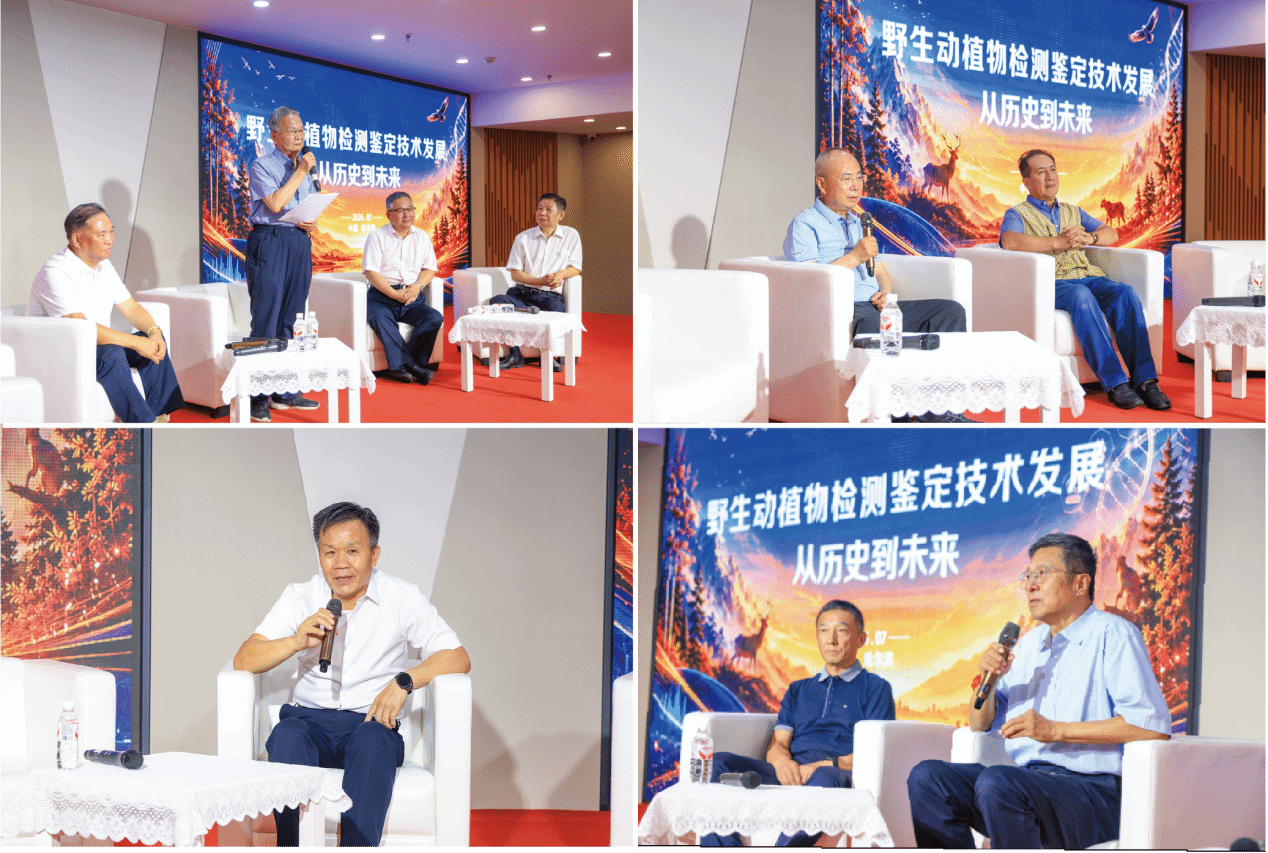
Representatives at the symposium shared their views.
Focusing on the latest academic frontiers, the conference featured four invited keynote presentations. Academician Liu Chao, drawing on the practical needs of forensic investigations, provided an in-depth discussion of the strategic direction for establishing the disciplinary framework of forensic zoology and offered forward-looking perspectives on its development. Chief Superintendent Tian Xuemei comprehensively reviewed the current state and major challenges facing forensic animal science, emphasizing that the key task is to move from having standards in place to ensuring that those standards are practical, applicable, and effectively implemented. She called for concerted efforts from multiple stakeholders to deepen the integration of disciplinary development with real-world applications. Professor Xu Yanchun, against the backdrop of the genomic era, proposed a next-generation DNA identification framework characterized by “decentralized wet-lab testing and centralized data analysis.” The approach offers new perspectives for improving the accessibility, convenience, and standardization of identification services. Professor Xue Xiaoming provided a comprehensive overview of the technical system for wildlife and plant identification and proposed systematic solutions to practical challenges, focusing on technological breakthroughs, standards development, and resource integration. The symposium also featured 26 thematic presentations and 10 poster presentations, covering a wide range of topics, including the development of new identification technologies, provenance tracing of challenging biological samples, analysis of practical issues in forensic identification, and the application of artificial intelligence to law-enforcement decision-making. Together, these presentations showcased the latest research, innovations, and practical achievements in wildlife and plant identification.
As the first major academic gathering dedicated to wildlife and plant identification in China, the symposium provided a high-level platform for experts and scholars from across China to exchange ideas and share expertise. It is hoped that the symposium will serve as a new starting point for building broader industry consensus, deepening academic and institutional collaboration, and jointly advancing wildlife and plant identification to a new stage of development.


 CN
CN